
Meditation Series Part One: The Order for Shekina Meditation.

Here I'll explain the form our meditations take. It works really well for us, and it's simple and lovely. (I'll be using parts of the Guide to Meditation that Cate wrote for us.) Shekina meditation is guided meditation, which we do sitting in a circle. In our communities different people take turns guiding, and the guide leads the people in the circle through each part of the meditation.
Shekina meditation has four main branches, with an optional discussion at the end. 

During the introduction, the guide will explain a little about our meditation. For instance, "Welcome to Shekina Meditation.  By use of the Holy Scriptures, we intend to create a safe place for the Divine Presence to speak. We have experienced and believe that God desires connection with us, and wants to visit us with wisdom and love.”

There may be other things that the guide brings up during the introduction. I sometimes mention that we are not alone in meditation. We are together as people, in our circle, and the Spirit of God is present in the room, the Divine Presence. The guide may give a short background on the scripture being read, if it is a scripture, without giving too much instruction into what the scripture means, since the point of the meditation is to be open and allow the Spirit to speak to each person.

The second branch of meditation is what we call the Preliminaries.

During the preliminaries, it is the guide's job to prepare those who are in the circle for meditation. We often arrive flustered and hot, straight from rushing from somewhere or (for me) from giving children their breakfast. The preliminaries take us past that and into a quiet space, ready for depth and silence.

*If you are doing this on your own, you should make sure to spend a good amount of time on preliminaries. I have arrived late at meditation and missed the preliminaries and the meditation was a totally different experience for me.*

The guide directs the people in the circle to focus their attention on the different physical and emotional realities of the moment.

She draws attention to breath. To sounds. To the fact that others are in the circle. She directs the people in the circle to take their cares and imagine putting them away for a while. To make a quiet space of expectation. She asks the people in the circle to slow their breath, to be comfortable, to relax their shoulders. She uses a lot of time to do this, silence and a calm voice.

This brings the circle into the next branch of our form. The meditation.

We always have content during meditation, and in the coming weeks I will introduce several types of meditation. This part of the time will usually run from 20 to 30 minutes, or maybe longer if the meditation involves moving around or going out and coming back (contemplation of nature, for example).

The main thing the guide (or you, if you are doing this on your own) needs to remember is not to be afraid of silence. The silence always feels longer for the guide! Others may just be entering into a dreamy vision or true depth with a scripture and a jumpy guide can rush the moment. Give a lot of space. Less is more. I'll cover this more in the different types of meditation.

The last branch of the meditation is sharing.

To us, sharing is an extension of meditation, as the act of sharing and of listening to one another is an act of love and receiving from one another. It is acknowledgement that we aren't doing this alone, that we are together, even in our silence.

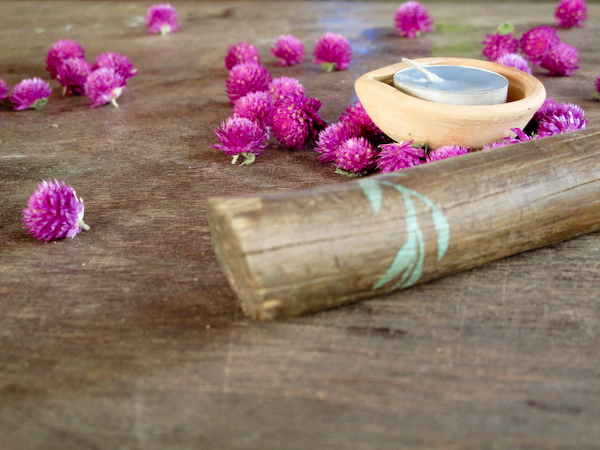
For our sharing times, we have a talking circle, passing a talking stick, a tradition that we got from Rainbow Gatherings, but which dates back to many First Nations tribes. The talking stick is a simple way to honor the speaking person. The rules of a talking circle are simple. The person holding the stick is the only one talking, with everyone else listening. The stick is passed around the circle and each person has the option to share or pass freely. We allow the stick to go around the circle twice, in order to give people more than one chance to speak. And the guide always explains the function of the talking circle, then passes the stick in order to let the person to her left or right go first.

During the talking circle, each person shares what occurred for him or her during the meditation. We really try to honor the time, to continue our quietness by listening, and when we have the stick, by not commenting on, correcting or responding to what any person says. It is a time to share briefly and personally, not a time to teach or give a long exposition. One of the main values of Shekina Meditation is to form a space that is open for people of any amount of experience with the Christian faith, from none whatsoever to years and years, so it is important that each person feels safe, welcome, and honored.

When the talking circle is over, the guide may feel led to offer a short prayer, or not. It is up to her to decide. She may also feel that it is a good idea to take a few more minutes of silence before heading straight into discussion. It really depends on how the group is, and how the meditation has gone.

There is often a time discussion after the talking circle, time that is more free. This would be the time for people to weigh in with their opinions and experience. (Respectfully, of course.)

And there it is, the structure we have been using for years now. The wonderful thing about this structure is that we find ourselves able to use it in any context, in any place. It is versatile and ready for the moment.

Next in this series, I'll be talking about the type of meditation we practice most: Lectio Divina.
Practice

"What is your practice?" you may ask someone. Depending on who they are, they may give any one of a myriad of responses.

"Sixty pushups, then a five mile run, every morning."

"A pint of ice cream in front of the TV after work."

"Sundays at the park, on a blanket, with a book."

"Scales for an hour, then whatever symphony I'm currently learning."

"Kung fu on Mondays and Thursdays."

In Christian spirituality, practice is essential if we want to walk a constant path, if we desire to transform along the way. Spiritual practice is anything repeated in the life of a believer, in the effort to move along on the journey of knowing God.

It could be the prayer you speak as you walk into the kitchen in the morning.

It could be a time of meditation, daily, or weekly.

It could be lighting the candles with the family in the evening, singing a song of thanks.

There are things that spiritual practice on the Jesus path is not. Our actions can not change certain immutable realities about God. With my practice I don't bring him closer, manifest anything or create anything. With or without my input, God is scarily brilliant, burning with love, less changeable than gravity. He simply is what he is: incredibly creative being, made up of good and love and terrifying strength.

The bizarre part is that there is a connection between us and this incredible being. We enter his presence knowing that we are there because he desires it to be so. He desires the space and time to dwell with us, to be circling our hearts as we wait. His heart is touched by our focus. He loves us. Crazy.

Practice is not a manipulation of God, it is not an act of changing the course of the stars. So what is it?

To put it simply, spiritual practice is a way of tricking our hearts to throw open their windows, letting light into our inner cramped, stuffy spaces.

When you practise something, you show up. As you show up day after day and you do the same thing, hopefully in the same place, you make a new crinkle in your brain. Something begins to click. You sit and your mind says, "Oh! Is it this time again? Already? Well, okay," and you've made it a hundred times easier to meditate, or pray, or open your mouth and sing.

I think the first place I discovered this was in my writing life. I learned to sit in the same place at the same time every day. I sat down and I wrote, just started. Usually, good things came. Somethings stupid, boring things came. But sitting down in that specific place unlocked the little attic door where the writing part of me lives. Doing it every day made sitting down and writing less like climbing a mountain and more like opening a door and stepping onto the front porch.

Now I rarely ever go a day without writing at least a thousand words. The more I write, the more I am open to words, thoughts and sentences appearing to me throughout my day.

I learned it next with meditation. Cate built an amazing community space in Goa, where we first started practising Shekina meditation. Now, four years later, just sitting in that space, looking at the way the light hits the red floor, I have all these memories of what it means to meditate, to sit with God in silence, waiting for his gentle words. I am immediately ready for meditation, just by sitting down. It is practice. I have good days and stupid days, where I can't reign my thoughts in. But over time, the good days out number the stupid ones by far. And the more I meditate, the more likely I am to be aware of love surrounding me all day long, the more likely I am to feel the abiding wonder of God.

There are so many spiritual practices on the Jesus path. The practice of humility, of kindness, of thankfulness, of trust. The practice of prayer and of singing. The practice of beauty and of hospitality. They are practices because they do not come naturally, without thinking, unless we have become so accustomed to the practice that they are as easy as breathing.

We do it because our minds are wonderful and slippery, capable of holding far too much information and swamping us with random trivia when we desire to be silent, or in prayer. We have to find ways to harness all that energy, to quiet the senses and make silence possible in our lives.

It's like traveling down the same road, day after day, to get home. You drive almost without thinking, keeping your eyes out for skateboards and children, for turning cars, but not really considering your route. "Home" has become engraved on your brain. So years later, after you move across town, you may be driving home after a long day and realize, suddenly, that you're on that old road home, headed back toward the old house. Your long practice has not allowed you to forget it.

This is practice. Carefully tracing out the road toward home, then taking that road again and again.

One Man's Opinion

So what are people experiencing in Meditation? Wow, great question. heres an answer (randomly selected from a pile of perfect answers) from someone new to the practice...

Today was my fourth time experiencing Shekina Meditation. However, it was my first time experiencing an imagination meditation. Rachel led the meditation. She chose the passage from the gospel story where Jesus miraculously calms a storm during a boat trip across Lake Galilee with his disciples. I was pleasantly surprised by the experience. At the beginning of the meditation Rachel led us to the shore amidst the crowds of people where Jesus was calling us to himself. We were encouraged to really experience being there. This was such a powerful experience for me. There was chaos on the shore—lots of people, and lots of commotion and confusion. Then I saw Jesus. He was amazing; I was enamored. Coming into his presence made all the chaos and confusion seem insignificant. He was so pure, strong and trustworthy. My soul was fully attracted to him. I felt peace. I felt safe. I felt fulfilled. I couldn’t even remember, let alone be bothered by the fact that a seemingly life-threatening storm was coming. I felt healing just by dwelling in this place where Jesus was. But then, we were led into the experience of the storm while crossing the lake. This experience was not so ostensibly pleasurable. I suddenly became confused. I didn’t understand why this was happening. The meditation became difficult at this point. But there was another breakthrough. I realized that the way I was feeling was similar to the other disciples in the boat. How quick we were to let our troubles and fears fog our minds, to turn back and doubt Jesus. But then Jesus calmed the storm, restored our faith and brought peace to our souls.


Let me say I’m not the type to have such profound experiences, which is why I was so surprised and thrilled that I had this one. I came to faith four years ago. For the first two years my doubts were based on intellectual struggles. I’ve pretty much dealt with those and now have a strong intellectual foundation for my faith. However, for the later two years up to the present, many of my doubts have more been based on not having enough of a fulfilling, personal, experiential relationship with God. Being that I don’t seem to be the type that’s wired for the more charismatic type experiences, I think I may have discovered a very powerful life-transforming spiritual discipline here with Shekina Meditation, especially through imagination meditation. It facilitates a personal encounter with Jesus, which in turn grows my relationship with him. All it takes is some time to sit down and imagine being with him. It’s so powerful because I know that it’s not simply fantasy imagination. I know that in doing this something real is actually happening. The Holy Spirit is present, truly ushering me into the presence of Jesus. Jesus is actually really ministering to me in this time. He’s renewing my mind and feeding my soul. I’m definitely coming back for more.

.....

Nice one! and also, here's a groovy icon. Although I don't  think they are sacred (sorry my earnest orthodox family!) and don't use them at all in my own practice, I love the artwork. And yeah, I think I get it, visual meditation.

icon

Shekina Meditation, like a block party, only quieter.

So here it is, a tidbit from a hebrew speaking person who has been coming to the meditation times with us. She wrote this in a shout out to some friends, and thought it was a good insight to share...

"Mmmm mysterious! Let me explain, for some days now I've been meditating on "shekina", which in the Hebrew simply means "to dwell" (shochen) Exodus 25:8 " ... Let them build Me a sanctuary that I may dwell (shocen) with them"

The letter goes on with more words from the Tanach and some seasons greetings, but the main point is right there. It's a good excuse to talk about part of the point, the reason behind of the whole thing, which might come in handy just about now.

It was something she said after the meditation jumped out to me like an indian cow on the highway. She mentioned that when she moved into new zip code in Israel, she had to talk about where she was and who she was, just a run of the mill newbie discussion with her budding hebrew skills.

Turns out she had to say the word for neighborhood (שכונה -Shechonah) and neighbor (שכן-shochen) alot. Did you catch it?  It comes from the same root word that we get shekina. A surprisingly common and familiar word to use for lofty God concepts, don't you think?

some hood

Dwelling, house, abode, living place. Dwelling meditation. Yeah, I like it.

So go with the thought, with the implications. God wants to live with you, in your hood?

Now that's something to meditate on. Often when we start, we invoke the hope and expectation that God would do just that, reveal the presence among us, like right then and there. True, its a sobering even high goal for a one hour circle on a rooftop, if you look at it one way.

On the other hand, anything less might just be a waste of time.

P.s. The newly minted "Bizaam! Insights" category could be full of stuff like this, and better.  You know, lightbulb moments you might get during the meditation time and in discussions after. Even juicy musings on the the topic by frequent flyers. So come on down, weigh in and let it loose man, we'll supply the pulpit.

Okay, pulpit is too strong. Look, don't get all preachy, nobody likes a know it all. Just say what you learned like a normal human being, ok? ;)